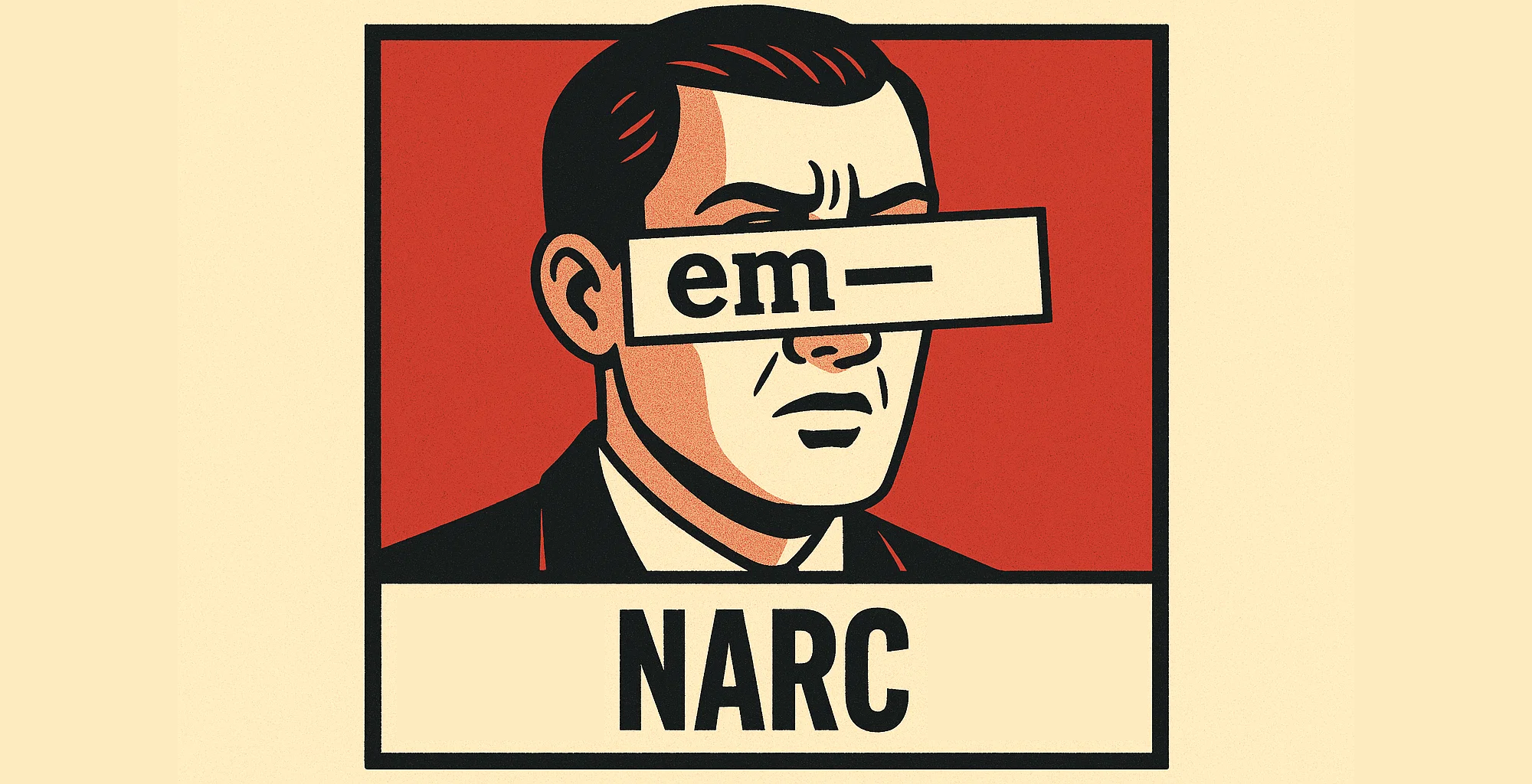
So this is how it ends—not with a bang, but with a stylistic fingerprint.
There was a time, long ago (2022 maybe), when I could dash my way through a sentence and no one batted an eye. I had alt-0151 on speed dial. It was my thing. Yours too, maybe. You knew what I meant when I said—
Wait for it—
Something unexpected.
The em dash was my pause, my detour, my breadcrumb trail through a chaotic thought. It was the breath between the punchline and the punch. It was, in short, punctuation for people who knew that language was jazz, and that good jazz always leaves the crowd a little confused.
But now? Now if I write a sentence—like this one—I’m accused of cheating.
The Robot Wrote That, Didn’t It?
That’s what they say now.
“I can tell you used ChatGPT” some guy will comment under your blog post or LinkedIn thought-nugget, because your sentence zigged when it should have zagged. Because it paused where only the overly articulate dare to pause. Because it bore the mark—the em dash—of the Machine.
Which is absurd, because I’ve been using em dashes since before OpenAI had opposable thumbs. I used them in high school essays about Slaughterhouse-Five. I used them in angry emails to landlords. I used them to flirt. And now? Now people assume my creativity was outsourced to a glorified calculator with delusions of Emily Dickinson (noted em dash lover).
Who Let the Toaster Write?
The cruel irony—Vonnegut would’ve appreciated this—is that the people who don’t use ChatGPT or Gemini are now perceived as if they do, simply because the robot learned to mimic style before it understood substance.
And one of its favorite tricks?
You already know the answer.
The em dash.
Congratulations—You’ve Been Stylized
It’s like finding out your quirky laugh is now the ringtone on 600,000 corporate phones. It used to be yours—yours and Henry James’s and David Foster Wallace’s and that one guy on Twitter who never used commas.
But now the em dash has gone corporate. It’s been productized. ChatGPT and Gemini deploy it like a ninja with a Word template. Every insight, every rejoinder, every simulated “human” moment comes dressed in dashes—synthetic pauses meant to feel natural.
And the worst part?
It works. It really does sound human. Like the kind of human who read a few New Yorker essays and drinks straight oat milk unironically—but human nonetheless.
So What Do We Do?
Nothing. That’s the Vonnegut answer.
You go on writing anyway. You use the em dash. You earn it.
You suffer the raised eyebrows, the “Nice ChatGPT draft, bro” comments, the quiet suspicion that your words are only as authentic as the code that could’ve written them.
And when people accuse you of using AI?
Lie.
Say you dictated it while driving through Santa Fe in a hailstorm. Say you carved it into a birch tree with a dull pocketknife. Say it came to you in a dream—a real one, not one trained on 45 terabytes of Reddit.
Because at the end of the day, we’re all just trying to say something worth saying—even if we have to punctuate it like machines do now.
So go ahead—write the sentence you mean to write.
Use the dash.
Live with the consequences. Or don’t.