Let me tell you about a time traveler named Morty who woke up one morning and couldn’t tell if the pancakes on his plate were real. They smelled like pancakes. They tasted like pancakes. They even had perfectly symmetrical blueberries, as if they were grown in a lab by a scientist with severe spherical OCD. But Morty had a creeping suspicion: maybe the pancakes were made by an AI. Maybe they weren’t pancakes at all, but edible metaphors for the future of the internet.
Welcome to the Great Content Collapse™.
Everything Looks Delicious and None of It Is Real
The world wide web. Once a sprawling library of rants, recipes, pr0n, and bad poetry is now a synthetic forest, full of AI-generated everything: text, images, videos, fake tweets, non-existent musicians with millions of plays, influencers with wash-a-board abs, perfect teeth, and no pores. Most of it is designed not to inform or inspire, but to get clicks, sow confusion, or train more AI.
That’s the thing. AI trains on AI. And then AI creates more AI to train the AI. It’s like incestuous inbreeding for algorithms. And what comes out the other end isn’t truth, it’s glossy, grammatically correct nonsense with heavy reliance on the once mighty em dash.
It used to be that “fake news” meant someone on Facebook shared a meme that claimed creamed spinach cured cancer. Now entire websites, deepfake journalists, and synthetic thought leaders are being scraped, reassembled, and presented as authoritative.
Has the Fake Internet Already Arrived?
Short answer: Yes.
Long answer: Absolutely yes, and it brought friends.
If you’ve ever read a blog post that was so clean, so SEO-optimized, and so utterly devoid of soul that it read like it was written by an unsleeping factory with no human workers… it probably was.
Fake product reviews? Check.
Fake political scandals? Check.
Obituary of someone who never lived? Check.
A shockingly popular non-existent Spotify artist? Check.
Reality has already become a funhouse mirror where the synthetic is indistinguishable from the authentic, unless you’re squinting through a monocle of paranoia, or doubt, which I am.
What We Need: An AI That Sniffs Out AI
I say: let’s fight AI with AI.
Let’s build an agent. A sarcastic, all-seeing, digital bloodhound that can analyze content and tell us:
“Hey, this video was stitched together by a neural net that’s never cried during a movie.”
-or-
“This article was written by something that’s never had pizza or a hangover, or pizza while hungover”
This AI wouldn’t just look for telltale signs like weird finger counts or scrambled metadata. It would look for semantic weirdness, syntactic sterility, and an utter lack of existential despair, all signs of non-human authorship.
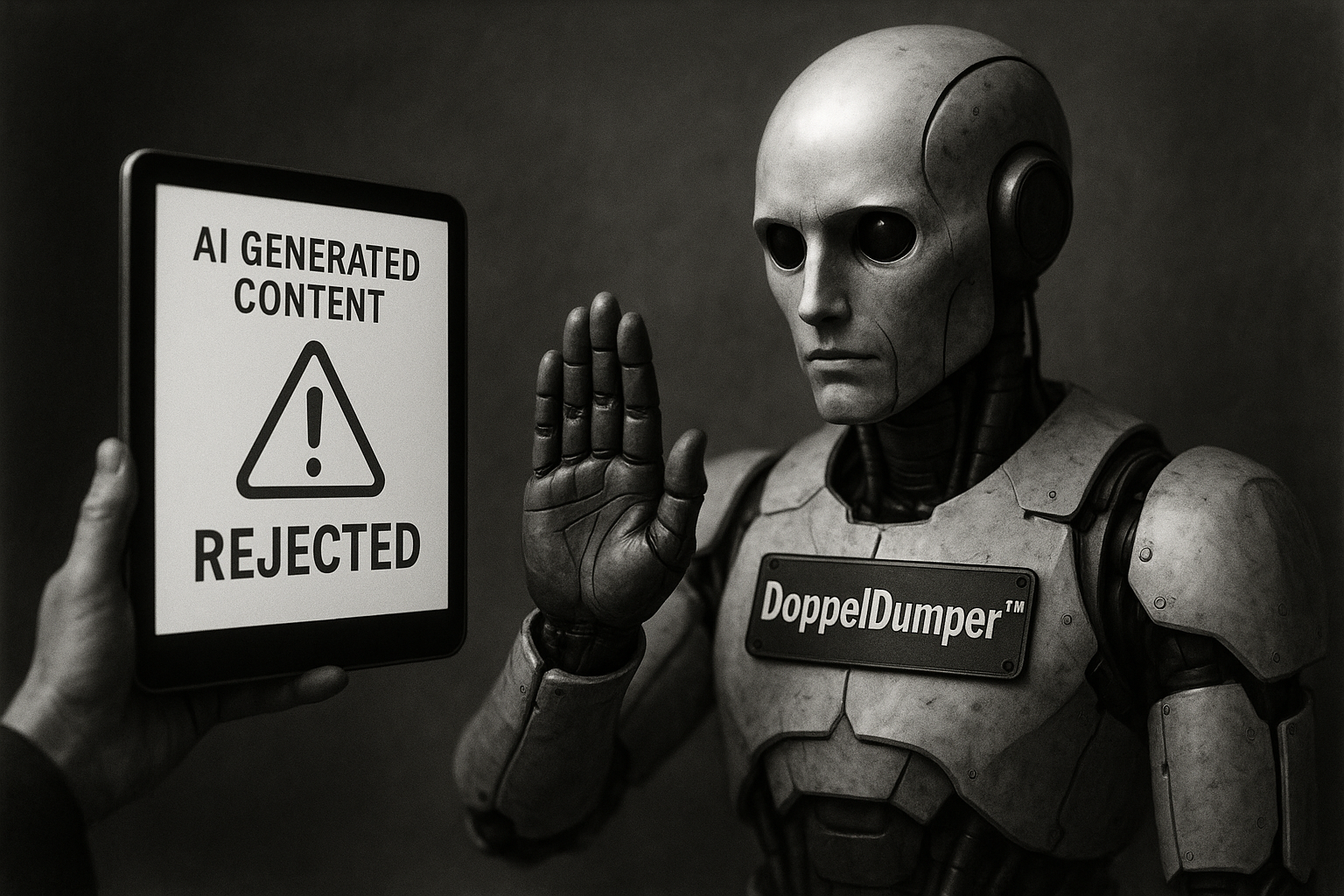
Let’s call it Doppeldumper™.
Because it detects the doppelgängers of truth. And also it’s a fun sounding word.
How Might It Work? Hypotheses from a Coffee-Stained Notebook
- Provenance Tagging at Creation
Embed metadata at content creation indicating:- Human-authored or AI-authored
- Tools used (e.g., GPT-4, DALL·E, Photoshop, actual brain)
- Authenticated digital signature of origin
- Fingerprinting for AI Content
AI-generated content tends to leave subtle patterns. Doppeldumper™ could analyze:- Syntax uniformity
- Frequency of unusual n-grams
- Lack of factual citations or verifiable sourcing
- Real-Time Verification Layer
As you scroll, Doppeldumper™ could slap on a tag:- Might Be Human
- AI-Generated: Style matches GPT-class models
- Possibly Nefarious Source: Low credibility + pattern match to disinfo network/examples
- Crowd-Verified Flags + Blockchain-ish Trails
Add community validation. Did five known humans confirm this article?
Use immutable, cryptographic ledgers to trace where content came from, like fair trade stickers for pixels.
Why Bother if the End is a Given?
Because if we don’t, we’re all just eating synthetic pancakes and pretending they taste like Mom used to make. Speaking of which, how did anybody ever keep buttermilk on hand? It only lasts for like a week. Crazy.
If we don’t mark what’s real, the illusion will become the standard, which it is fast becoming already. And when illusion is standard, trust dies (not that I trust anything at first impression anyhow). And when trust dies, society isn’t terribly far behind. It’s just a bunch of devices muttering opinions to each other until the sun explodes.
But maybe, just maybe, Doppeldumper™ shows up.
Maybe your feed becomes a little brighter, a little more honest. Maybe the real things, the human things, start to shine again. Even though cynical me wonders how they’ll monetize and re-monetize the human bit, because that’s the only real driver of change. Slightly less cynical me says:
Let’s build it.
Let’s train it.
Make it roll its virtual eyes at fake content and whisper, “Nice try, robot.”
And when it saves your sanity for the fiftieth time that day, don’t forget to thank it.
Or better yet, thank yourself.
You’re still real.
For now.